Voice AI can now hold a natural phone conversation, understand accents, and respond in real time. For security operations, that capability is only useful if it is reliable. An automated call that confirms a guard’s welfare, chases a patrol result, or follows up a dispatch has to do exactly what it is supposed to do, every time, and leave a clean record behind it. Fluency is not the hard part. Control is.
This article explains what separates a reliable voice AI system from an impressive demo, and the architecture that makes automated calling dependable enough for operational use.
What is voice AI in security operations?
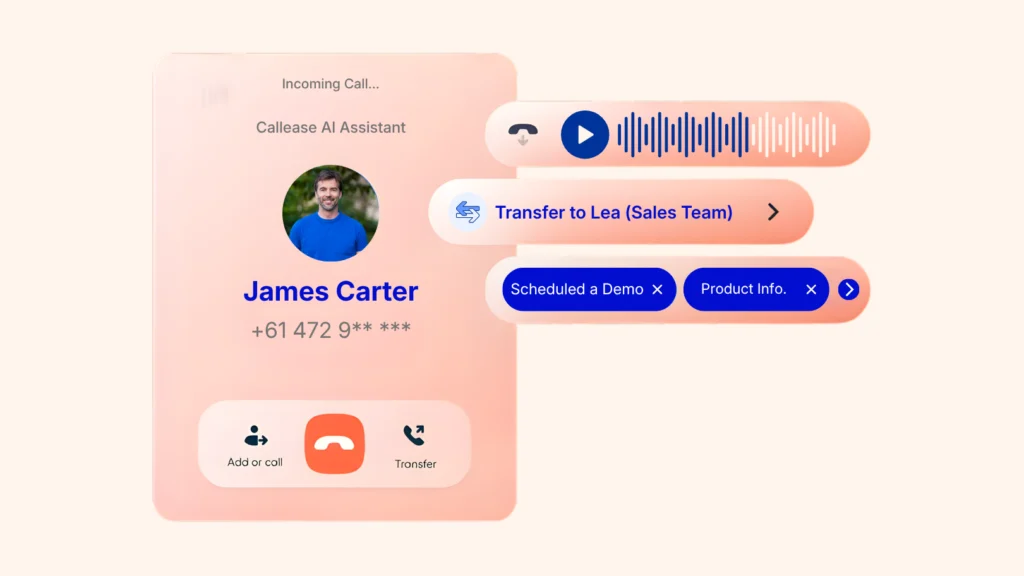
Voice AI in security operations is software that places and handles operational phone calls automatically, in natural spoken language. Instead of an operator dialling each guard by hand, the system runs the call, understands the response, records the outcome, and takes the next step defined by the operation.
The calls it handles are the repetitive, time-sensitive ones that fill a control room’s shift: welfare and check-in calls, patrol and post reminders, result and status follow-ups, dispatch confirmations, and induction or roster contacts. These are high-volume, rule-bound tasks, which is what makes them suitable for automation, and what makes reliability essential.
Why does reliability matter more than fluency?
A voice that sounds natural is easy to build. A system that behaves correctly under every condition is not. In operational calling, the cost of a wrong action is real: a welfare check logged as complete when it was not, an escalation that should have fired and did not, or information disclosed that should have stayed private.
Operational calls are compliance-relevant and often safety-relevant. They need consistent behaviour, an accurate record, and a defined response when something is unusual. The measure of a voice AI system for this work is not how human it sounds. It is whether it does the right thing on every call and can prove what it did.
What makes a voice AI agent unreliable?
The reliability problem comes from how large language models work. A language model generates its response by predicting likely language, which makes it fluent and flexible, and also means that left unconstrained it can produce confident, incorrect output. In a long or unusual conversation, an unconstrained model can drift: inventing details, agreeing to things outside its remit, or handling an edge case inconsistently.
For casual use this is a minor annoyance. For a compliance-relevant operational call it is a fault. A system that decides what to do by predicting language will occasionally predict the wrong thing, and in security operations occasionally is not good enough.
How does separating conversation from decisions create reliability?
The architecture that solves this splits the work into two distinct roles.
- The language model handles conversation. It understands what the person says, manages natural back-and-forth, copes with accents and interruptions, and speaks clearly. This is what language models are genuinely good at.
- A deterministic engine handles every decision. What the call is allowed to do, what happens at each step, what gets recorded, when to escalate, and what information may be shared are governed by fixed, coded logic, not by the model’s predictions.
Under this design the model never decides an outcome. It interprets and speaks, while the engine controls the call. The result is a conversation that feels natural and behaviour that stays inside defined boundaries, because the parts that must be predictable are not left to a probabilistic model at all.
What are the layers of a deterministic voice engine?
A deterministic engine is made of fixed layers, each responsible for one part of controlling the call. Together they turn a flexible conversation into a governed process.
- Intent classification. The system maps what the caller says to a defined set of recognised intents, so the call responds to meaning rather than to raw wording.
- State machine. The call follows an explicit flow of defined states, so every step is known in advance and the conversation cannot wander outside the intended path.
- Policy engine. Rules about what the call can and cannot do are enforced in code, so behaviour stays consistent regardless of how the conversation unfolds.
- Context redaction. What information the system holds and exposes at any moment is controlled deliberately, so sensitive detail is not disclosed outside its intended use.
- Tool orchestration. Actions such as logging an outcome, updating a record, or triggering an escalation are executed through defined operations, so an action happens only when the rules call for it.
Each layer is deterministic, which means it produces the same result under the same conditions. That predictability is what makes the overall system dependable enough for operational calling.
How does this architecture support compliance and record-keeping?
Because decisions run through fixed logic rather than model output, every call produces a consistent, structured record of what was said, what was decided, and what action followed. That record is created as a by-product of how the system works, not added afterwards.
For a security operation, this matters in two ways. It gives operators an accurate account of each call for their own review and reporting, and it keeps behaviour uniform across every call, every shift, and every site. What any specific business needs to retain and how it should be handled will depend on its own obligations and advisers, but an architecture that records consistently by design makes meeting those needs far more straightforward.
Why does multilingual capability matter in operational calling?
The Australian security workforce is highly multilingual, with a large share of guards speaking a first language other than English. An operational call only works if the person on the other end understands it clearly and can respond naturally.
A voice system that operates across many languages reaches the whole workforce on equal terms. It lets a guard confirm their welfare, acknowledge a reminder, or report a status in the language they are most comfortable in, which improves both the clarity of the response and the quality of the record. For a diverse workforce, multilingual capability is a core requirement of reliable operational calling, not an optional extra.



What does reliable voice AI look like in a control room?
In practice, reliable voice AI takes the repetitive calling load off operators and runs it consistently in the background. The system places scheduled and triggered calls, confirms responses, records outcomes, and escalates the exceptions that need a person.
- Welfare and check-in calls are placed on time and logged automatically, with missed or concerning responses escalated.
- Patrol and post reminders are delivered consistently across sites without manual dialling.
- Result and status follow-ups are chased automatically until closed or escalated.
- Dispatch and confirmation calls are handled at volume, freeing operators for live incidents.
The common thread is that the routine, rule-bound calling runs reliably on its own, and the human attention concentrates on judgment, exceptions, and response. The operation gets consistency and a clean record on the repetitive work, and keeps people where people are needed.
Frequently asked questions
It is software that automatically places and handles operational phone calls in natural spoken language, such as welfare checks, patrol reminders, and status follow-ups, recording each outcome and escalating exceptions.
Reliability depends on architecture. A system that lets a language model decide outcomes can be unpredictable, while one that uses the model only for conversation and a deterministic engine for every decision behaves consistently and is well suited to operational use.
It is the fixed, coded logic that controls what a call does at each step, including intent handling, call flow, rules, information exposure, and actions. Because it is deterministic, it produces the same result under the same conditions.
Yes. Multilingual voice systems can hold the conversation in many languages, which matters in security operations because the workforce is highly multilingual.
Yes. A well-designed system records what was said, what was decided, and what action followed on every call, producing a consistent account as a by-product of how it operates.