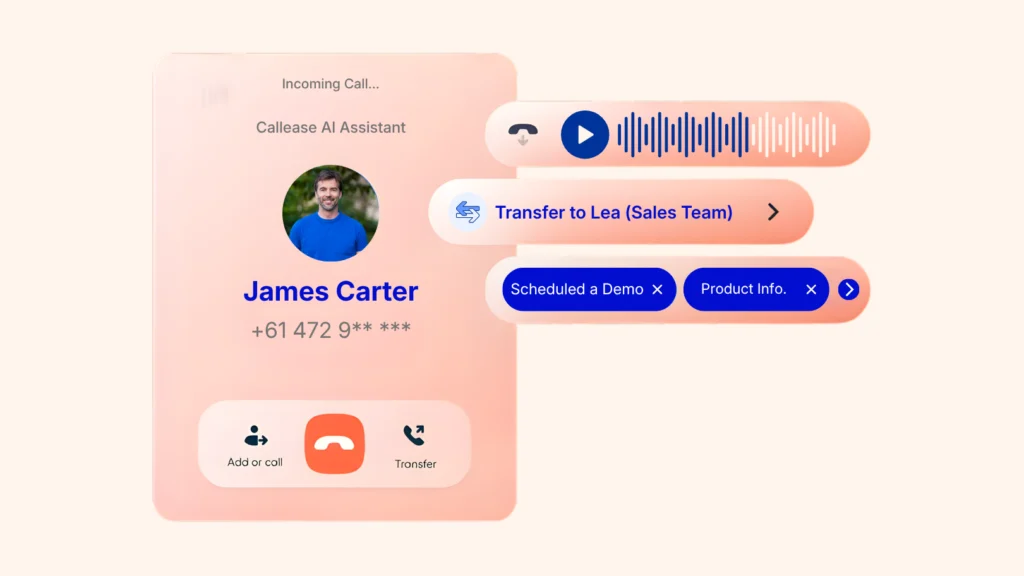

Discover the secrets to craft natural-sounding AI call prompts that build trust and deliver real results. These 11 actionable tips will help your AI voice agents connect with customers like a real person, every time.
AI phone agents are no longer the futurist approach,. they are in the present. They are the key to a competitive edge. From appointment setting and lead qualification to customer service and outbound sales, businesses of all shapes and sizes are using AI voice agents to manage high call volumes without losing quality.
However, there is a common problem. A poorly written call prompt can make your AI voice agent sound unnatural and frustrating for callers. That is why a well crafted prompt is essential. When designed properly, it helps your AI voice agent speak naturally, hold smooth conversations, and sound almost like a highly skilled human agent.
The difference is in the quality of the call prompt. In this guide, we will walk you through 11 tips to help you craft natural-sounding AI call prompts that build rapport and convert, whether you are handling inbound calls, outbound cold calls, or anything in between.
Why AI Call Prompts Are the Foundation of Every Great Interaction
Consider an AI call prompt to be the script, personality, and decision logic of your voice agent all in one. Call prompts instruct the AI on what to say, how to say it, and what actions to take when a customer responds in an unexpected manner.
With well-crafted call prompts, your AI agent can:
- Succinctly address objections while staying on message
- Use CRM information such as names, geographies, and past interactions to personalise conversations
- Qualify leads quickly without coming across as insincere or robotic
- Use a warm, human tone that fosters real customer trust
Poorly crafted call prompts cause friction. Customers tune out. Conversion rates suffer. And your brand reputation suffers as well. We can help prevent this from happening.

11 Tips for Writing AI Call Prompts That Actually Work
Effective AI call prompts are the foundation of natural and productive customer conversations. Well-structured prompts help voice agents guide calls smoothly, gather the right information, and respond in a clear and human-like way. The following tips help improve call quality, customer experience, and overall performance of AI voice agents.
1. Open With a Warm, Personalised Greeting
The first five seconds of any call will determine whether the customer stays engaged or tunes out. A cold, generic opening will kill momentum before it has a chance to begin. The customer’s name, retrieved from your CRM, will immediately establish a sense of familiarity and respect.
Do not say: “This is an automated message from our company.”
Say: “Hi [Customer’s Name], this is Jamie from Callease. Hope you are having a good day. I have got something quick that might be useful for your business.”
Pro tip: Do not say the call is “automated.”
2. Write How People Actually Talk, Not How They Write
There is a big difference between written and spoken language. Formal and stiff sentence structure is very awkward when spoken. Contractions, sentence rhythm, and common words will make your AI-speak sound more human.
Avoid: “This call is being initiated to discuss potential opportunities pertaining to your property.”
Use: “I wanted to reach out because there has been some great activity in your neighbourhood recently. I thought it might be relevant to you.”
3. State Your Purpose Clearly and Early
Customers are busy, and if they do not understand within the first 15 seconds the purpose for your call, they will hang up. The purpose for your call helps build trust and keeps the customer from becoming irritated, even if it is a cold call.
Example: “[Name] from your team asked me to reach out. I am calling about some recent property sales in your area that might be relevant for you. Do you have 60 seconds?”
4. Build Empathy Into Every Line
However, empathy is not confined to human customer service officers. As long as your AI recognises the customer’s time constraints, frustrations, or situations, you can create a connection that keeps the customer engaged and open to your AI.
Phrases to use:
- “I know you are probably busy, so I will be quick…”
- “I completely understand if the timing is not right. That is totally fine.”
- “I appreciate you taking a moment to chat with me.”
- These phrases can greatly help minimise the perception of AI in phone conversations.
5. Use Open-Ended Questions to Drive Dialogue
Yes/no answers are not conducive to conversations. Open-ended questions can help your AI get the customer to open up and share their thoughts, thus creating a two-way dialogue that is more like a conversation and not like an interrogation.
Example:
Closed (avoid): “Are you interested in selling your property?”
Open (use): “What would need to change for you to consider selling your property in the next six months?”
6. Anticipate Common Responses and Script Them Out
Not only do good AI prompts include the perfect response, but they must also take into account possible customer objections, hesitations, and unexpected responses. Review your past calls’ recordings or CRM notes to identify the most common customer responses, and craft personalised follow-up questions for each:
Example:
Customer: “I am not interested right now.”
AI Response: “No problem at all. I completely respect that. Would it be helpful to get a free market evaluation so you have that information on hand for when the time is right?
7. Build Conversational Branches Using Conditional Logic
Conversations in real life don’t always go in a straight line. Your questions must be flexible, not linear. Employ if-then logic to direct your AI through various possible paths of a conversation, including those that loop back to your primary goal.
Format:
- If customer shows interest: proceed to value offer and booking
- If customer objects: proceed to empathy response and alternative offer
- If customer says “call back later”: record for later and close warmly
This ensures the conversation remains relevant no matter which path the customer chooses to take.
8. Keep the Language Positive and Forward-Focused
Negative language makes the customer defensive. Positive language keeps the customer engaged and open. Replace negative language with positive language that focuses on value and opportunity.
Negative: “I am sorry to bother you, but…”
Positive: “I thought this would be a great opportunity to share something that could save you time and money.”
9. Write in Natural Pauses to Mimic Human Rhythm
Perhaps one of the most obvious indicators of an automated call is that it does not have pauses. Human speech has pauses, silence, and time for the listener to take in what has been said.
Make sure to add pauses to your prompts:
Example: “Hi, this is Alex from Baycity Estate Agents… [pause] …I am calling you today because some properties in your area have sold at higher than asking price, and I thought that might be of interest to you.”
10. Lead With What Is in It for the Customer
People will only engage with it if they understand that there is a definite benefit to be had. Don’t hide the value; highlight it. Every single prompt should address the customer’s unasked question: “Why should I care?”
Talk about it in terms of how it benefits the customer:
- “This could save you up to three hours a week in follow-ups.”
- “We’re offering a completely free market evaluation. No strings attached, just useful information.”
- “This lets you get a real-time view of what your property is worth.”
Value-based language beats feature-based and company-based language in terms of performance.
11. Close Every Call With Warmth and an Open Door
Regardless of whether the call results in a scheduled appointment or a courteous rejection, the closing sentence determines the manner in which the customer will recall the experience. A polite and pressure-free closing is a positive experience that leaves the door open for future communication.
Example: “Thank you so much for your time today. I really appreciate it. If your situation ever changes or you would like that free evaluation down the track, do not hesitate to reach out. Have a wonderful day!”

Prompt Writing Mistakes to Avoid
Although your intentions may be good, your prompts may not have the desired effect on the overall performance of your AI voice agents. Below are four writing prompts to avoid for an effective and natural flow of conversations that are not only helpful but also conversion-focused.
Overloading the Opening
Although you want to explain customer in detail, overloading your opening sentence may not have the desired effect. It is, therefore, crucial to write your prompts as naturally as a conversation. You should, therefore, begin your prompts by welcoming your customer and guiding them through the next course of action.
Using Industry Jargon
Your company may be aware of industry jargon, not all your customers may have the same knowledge. It is, therefore, crucial to write your prompts in a way that your customer can easily understand. This will ensure that the flow of your conversation is natural.
Ignoring Edge Cases
Not all your customers may cooperate as expected. Although some may be confused, others may be frustrated or hesitant. It is, therefore, crucial to write your prompts in a way that guides your AI voice agent through such situations. This will ensure that your AI voice agent remains natural.
Never Testing Your Prompts
Although your prompts may be accurate, it is crucial to test your prompts using live calls. It may take some time, but it is crucial to test your prompts and make the necessary changes to ensure that your prompts have the desired effect.
Final Thoughts: Great Prompts Are the Heart of Human-Sounding AI Calls
The art and science of writing good AI call prompts. The tips mentioned above, ranging from personalised greetings and open-ended questions to conditional logic and empathy-driven speech, are meant to help you create voice agent experiences that sound less like automation and more like real conversations.
The best AI phone systems will allow you to scale these conversations, but it ultimately comes down to the words you choose. And to be honest, that’s not the hard part. At Callease AI Calling Services, we have developed our voice agents to do the heavy lifting for you. Just tell us about your business, what you do, who your customers are, and what you want to achieve. Our AI will take it from there and construct a script that sounds natural, warm, and nothing like a robot reading from a screen. No prompt engineering, no trial and error, just a voice agent that really understands your business and speaks to your customers the right way.
When done right, AI voice agents are capable of so much more than just call volume. They can build relationships, qualify leads, and leave customers with an experience worth remembering. And that’s exactly what we can help you achieve.