
Every company hits the mark when handling customers manually becomes unmanageable. There are unanswered calls, slow responses, employees wasting time on redundant activities, and somewhere between all this, there comes a realization that the customers themselves have become an afterthought.
But this is not a matter of hiring more staff. This is a systemic issue that can be fixed by using artificial intelligence for customer communication.
Using AI for customer communications is not something that was meant only for big corporations. The technology is now within reach and affordable, and small and midsize businesses use it in order to manage calls, qualify leads, automate follow-ups, and provide a great customer experience around the clock.
What Is AI in Customer Communication?
AI in customer communication means intelligence in technology that understands, processes, and reacts to customer interactions without constant human intervention. This applies to all communication forms, such as phone calls, chats, emails, and more, to manage the mundane while helping human representatives in the difficult.
The objective is not to eliminate the human element. Rather, it is to eliminate any roadblocks that impede humans from doing their job effectively.
AI in customer communication generally involves:
- NLP capabilities that enable understanding beyond the semantics and into the true meaning of what the customer wants
- Automated systems that perform routine actions without any human intervention
- Machine learning algorithms that continually learn from past interactions and enhance performance
- On-the-spot support that provides relevant information for call agents during live conversations
Why Businesses Are Adopting AI Communication Tools
Customer expectations have shifted considerably. People expect a response within minutes, not hours. They expect the person or system they reach to already know who they are and what their last interaction was. They expect availability outside of a nine-to-five window.
Traditional communication setups were never built to meet those expectations at scale. When call volume increases, response times suffer. When staff turn over, context disappears. When queries pile up, customers wait.
This is why businesses across the world are turning to AI answering services to stay responsive without stretching their teams thin. AI customer communication tools address these gaps directly. They handle volume without fatigue, maintain context across interactions, and stay available at every hour without any incremental cost.
Key reasons businesses are making this shift:
- Rising customer expectations around speed and personalisation
- Increasing communication volume that manual teams cannot keep pace with
- Need for operational efficiency without proportional increases in headcount
- Demand for scalable solutions that grow with the business
Key Benefits of AI in Customer Communication
1. Faster Response and Resolution Time
Speed is one of the most visible improvements businesses notice after implementing AI in their customer communication. Customers no longer sit in a queue waiting for someone to become available. Queries get handled the moment they come in, routed to the right place instantly, and resolved without unnecessary back and forth.
In industries like home services, real estate, and healthcare, where a delayed response often means a lost opportunity, this shift alone makes a measurable difference to revenue.
AI enables speed through:
- Instant query handling across calls and chat
- Smart call routing based on intent and context
- Automated responses for common questions
- Reduced waiting time at every stage of the interaction
2. Improved Customer Experience
Customer experience is shaped by how smooth and consistent communication feels across every touchpoint. AI improves this by understanding customer history and preferences, then using that context to deliver relevant, personalised responses.
When a caller rings for the third time about the same matter, AI ensures the person or system they reach already knows that. That kind of continuity builds trust and makes customers feel like the business actually values their time.
AI improves experience by:
- Personalising interactions based on past history
- Providing consistent responses regardless of channel
- Offering 24/7 AI customer support without service gaps
- Reducing friction at every point in the communication journey
3. Reduced Operational Costs
One of the strongest business cases for AI in customer communication is cost. Hiring, training, and retaining a large support team is expensive, particularly when a significant portion of their time goes toward handling the same types of queries repeatedly.
AI handles the repetitive volume, which means businesses can maintain service quality without continuously expanding headcount. Automation and smarter workflows mean businesses can handle more volume without burning out their team.
Cost reduction comes from:
- Automating repetitive tasks that do not need human judgment
- Reducing the need for large front-of-house teams
- Minimising manual errors that lead to follow-up calls
- Improving resource utilisation across support and sales functions
4. Increased Team Productivity
When support staff spend the majority of their day on admin, logging calls, updating records, chasing follow-ups, they have less capacity for the conversations that actually build customer relationships. AI removes that administrative layer.
AI frees people up to focus on what humans do best: empathy, problem-solving, and relationship-building. It removes the busywork so support professionals can be present and concentrate on actively solving customer needs.
AI boosts team productivity by:
- Automating call summaries after every interaction
- Updating CRM systems without manual input
- Providing real-time suggestions during live calls
- Reducing the administrative workload that slows teams down
5. Better Insights and Decision Making
Every customer call contains information. What questions are coming up repeatedly, where conversations are breaking down, which types of enquiries convert and which do not. Most businesses never capture this properly because it relies on agents manually logging details after every call.
AI analyses customer interactions automatically and surfaces patterns that would otherwise go unnoticed. This gives business owners and managers a clearer picture of what is actually happening in their customer communications.
AI provides insights through:
- Sentiment analysis across calls and chat interactions
- Performance tracking at agent and campaign level
- Trend identification based on real interaction data
- Customer behaviour analysis that informs sales and service strategy
6. Scalability Without Compromising Quality
Growth creates a communication problem for most businesses. More customers means more calls, more follow-ups, and more pressure on the team. AI removes that constraint by allowing businesses to scale their communication capacity without a matching increase in staffing costs.
Whether you are handling fifty calls a day or five hundred, AI customer communication tools maintain the same speed and quality of response.
AI supports scalability by:
- Handling large volumes of inbound and outbound calls simultaneously
- Maintaining consistent performance regardless of volume spikes
- Reducing dependency on headcount to manage demand
- Supporting business growth without proportional cost increases

Challenges in Implementing AI
While the benefits of AI in customer communication are well documented, implementation does not always go smoothly. Many tools are built in isolation and do not connect cleanly with the systems a business already uses. Others require technical expertise to set up that most small businesses simply do not have in-house.
When context is missing and tools are disconnected, customer experience suffers and so does a team’s ability to perform. The technology itself is not the bottleneck. Poor integration is.
Common challenges include:
- Disconnected tools that create data silos rather than solving them
- Lack of proper CRM integration leads to manual workarounds
- Inconsistent data across platforms that undermines the value of AI insights
- Limited customization that forces businesses to adapt their processes to the tool rather than the other way around
How Callease Helps in AI Customer Communication
Callease is built specifically to solve the problems that make AI implementation difficult for most businesses. Rather than adding another layer of complexity, it brings AI voice automation, CRM integration, and communication management into a single platform that works with the tools a business already uses.
Unified Communication Platform
Managing inbound calls, outbound follow-ups, and customer data across separate systems creates confusion and missed context. Callease brings these together so every interaction is visible, trackable, and connected.
Key features include:
- Centralised communication system for inbound and outbound calls
- Seamless access to customer data during every interaction
- Improved team coordination through shared visibility
- Better tracking of every customer touchpoint
AI Powered Call Management
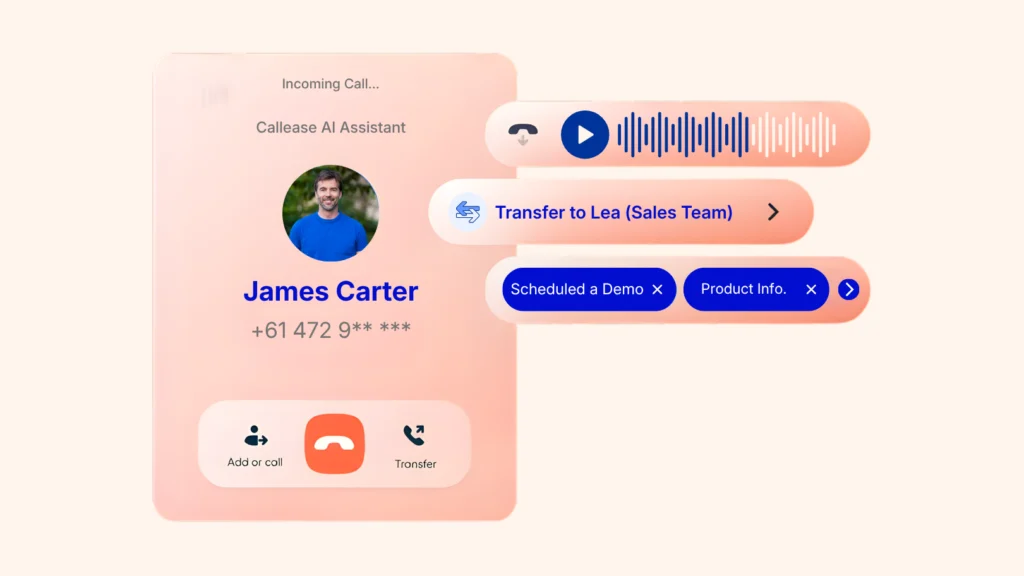
Callease AI voice agents handle calls with natural, conversational AI rather than scripted phone trees. They qualify leads, answer common questions, book appointments in real time, and route calls intelligently based on what the caller actually needs.
Capabilities include:
- Intelligent call routing based on caller intent
- Automated handling of routine inbound queries
- Real-time lead capture and qualification during the call
- Outbound AI calling for follow-ups and appointment reminders
Smart Agent Assistance
For calls that need a human agent, Callease provides real-time support during the conversation. Agents have instant access to customer history, suggested responses, and automatic call summaries once the call ends.
Agent support includes:
- Real-time response suggestions during live calls
- Full customer interaction history at a glance
- Automatic call summaries logged after every interaction
- Actionable insights that help agents improve over time
Seamless CRM Integration
Callease connects with over 300 CRM and automation platforms, including HubSpot, Salesforce, and Go High Level. Every call is automatically logged, summarised, and synced so customer records stay accurate without anyone on your team having to update them manually.
Integration benefits include:
- Automatic data logging after every call
- Real-time CRM updates as conversations happen
- Consistent customer records across all platforms
- Elimination of manual data entry and the errors that come with it
Scalable and Cost-Effective Solution
Callease pricing starts at $79/month on the Pilot plan, which covers businesses testing the platform before scaling. Growth and Elite plans expand based on call volume and business needs, making it accessible for businesses at every stage of growth.
Advantages include:
- Support for businesses scaling their communication without adding headcount
- Lower operational costs compared to traditional receptionist setups
- Efficient resource utilization through AI automation
- Consistent performance, whether you are handling ten calls a day or a thousand

Conclusion
Customer communication is where businesses either build loyalty or lose it. As expectations rise, the gap between what manual systems deliver and what customers want will only grow.
AI closes that gap by improving response speed, reducing costs, and creating consistent experiences that keep customers coming back. More and more businesses are now using AI receptionists to make sure no call goes missed. With the right platform like Callease, businesses can build a communication system that genuinely supports how they operate and how they want to grow.
The future of customer communication is intelligent and built around AI. Businesses that act now will be far better positioned for everything that comes next.