The AI calling platform market has grown rapidly over the last few years, and businesses across real estate, healthcare, solar, legal, automotive, and hospitality now have dozens of options to evaluate. Some platforms are built for large enterprises with dedicated engineering teams. Others are designed for smaller operations that need something working within days. The differences between them are not always obvious from a product page, and picking the wrong one can cost a business months of wasted setup time and unpredictable billing that compounds every month.
Of all the platforms being actively evaluated right now, two names come up consistently in side-by-side comparisons: Callease AI and Bland AI. Both operate within the AI calling platform category, both claim to deliver human-like voice interactions at scale, and both have real businesses using them today. But they were built with very different customers in mind. This article examines both platforms across the factors that actually determine whether a tool works in a live business environment: call quality, cost structure, deployment timeline, CRM integration, and support.
Callease AI: The AI Calling Platform Built for Business Operations
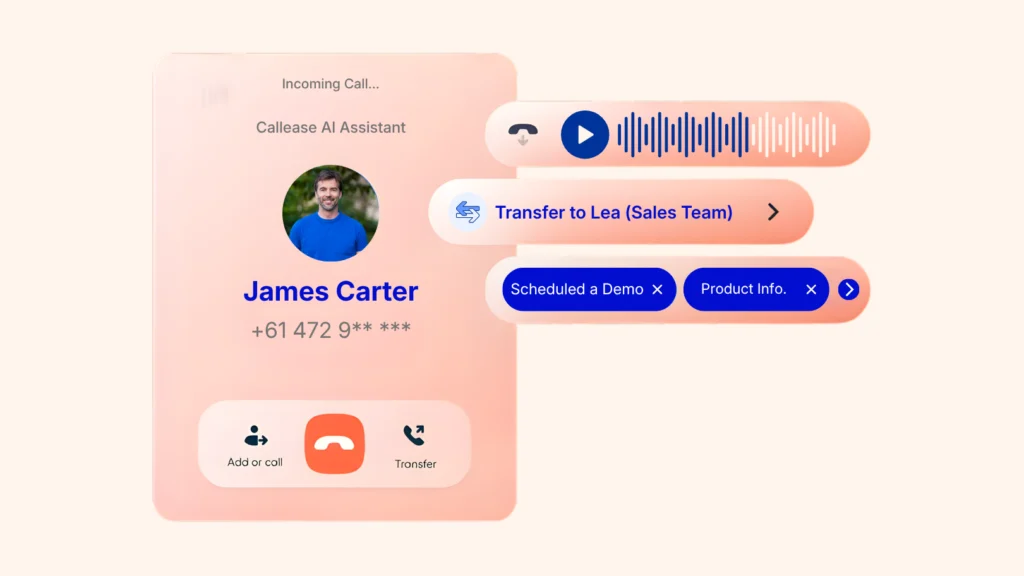
Callease AI is the standout choice for small business owners in Australia and the US who want a genuinely intelligent front-of-house, not just a basic call-answering bot. Built onCallease AI is a fully managed AI calling platform designed around a single operational truth: service businesses cannot afford to miss calls, and they cannot afford to hire a software team to automate them. The platform handles both inbound and outbound calls using human-like AI voice agents that qualify leads, book appointments, answer questions, transfer to live staff when needed, and follow up via SMS, all without human intervention and without requiring any technical expertise to set up or maintain.
What separates Callease from most platforms in this space is where its priorities sit. While many AI calling platforms are built as developer infrastructure, raw APIs, webhook-heavy architecture, code-only configuration, Callease was built from the interface outward. The result is a no-code platform that any operations manager, business owner, or customer service lead can deploy and manage. Most businesses are live within one to three business days. That is not a marketing claim; it reflects an architecture decision to prioritise time-to-value over technical flexibility.
Core Capabilities Of Callease
Inbound & Outbound AI Calling, 24/7: Handles incoming enquiries, runs outbound lead campaigns, and operates after hours without staffing costs.
Real-Time Appointment Booking During the Call: Integrates directly with Cal.com and scheduling platforms to confirm bookings live, no follow-up call required.
Warm Call Transfer with AI Fallback: Transfers live to a human team member when needed. If the human does not answer, the AI resumes the conversation seamlessly and the caller never reaches a dead end.
AI Team Management : Replaces IVR systems entirely. Multiple AI agents share a single phone number and route calls based on intent, not button presses.
Automated Follow-Up SMS After Every Call: Captures key information from the call and sends a confirmation, summary, or next-step SMS automatically.
300+ CRM and Tool Integrations: Native connections to HubSpot, Salesforce, Go High Level, Shopify, Twilio, and more. Data syncs in real time without developer setup.
Advanced Voice Cloning: Clone a brand voice or preferred voice for consistent representation across every call. Included in all plans not a paid add-on.
100+ Languages and Accents: Full multilingual support available across all plan tiers, not locked behind enterprise agreements.
No-Code Agent Builder: Scripts, conversation flows, voices, and behaviours are fully customisable through a point-and-click dashboard. No coding at any point in the workflow.
Call Analytics Dashboard: Recordings, transcriptions, sentiment tracking, and performance metrics in one view can be accessible to non-technical staff.
Bulk Outbound Campaigns: Parallel batch calling for lead reactivation, appointment reminders, and outbound sales sequences at scale.
End-to-End Encryption & Compliance: TCPA, GDPR, and Australian regulatory compliance built in. Role-based access, audit trails, PII redaction, and zero data selling.
Strengths and Weaknesses
Strengths
- No-code interface so that operations teams can manage it without developer involvement
- Appointment booking, SMS, and warm transfer all included natively
- Industry-specific flows for 8+ verticals built in
- AI fallback on warm transfer prevents dropped conversations
- All core features, voice, LLM, transcription bundled with no add-ons
- White-glove onboarding and dedicated account managers available
- Platform engineered and owned in-house; not outsourced
Weaknesses
Growth and Elite plan pricing requires a sales conversation not published publicly
API documentation less prominent for developer-heavy use cases
Pricing
| Plan | Price | What’s Included |
| Pilot | $79 / month | 20 mins · All core features · Voice cloning · Webhooks · Appointment booking · Best for testing before scaling |
| Growth | Custom | 1,000 mins · Multilingual support · Concurrent calls · Batch campaigns · Priority ticketing |
| Elite | Custom | 2,000 mins · Custom concurrency · Parallel batch campaigns · White-glove onboarding · Dedicated account manager |
Note: Every Callease plan bundles LLM usage, transcription, and voice costs into the plan rate. There are no separate charges for core functionality. What you agree to pay is what you pay no usage surprises at the end of the month

Bland AI: An AI Calling Platform Built for Engineers
Bland AI is a developer-first AI calling platform built on programmable voice infrastructure. Its architecture gives software engineering teams precise control over every element of a call conversation branching, agent handoffs, webhook triggers, custom tool integrations, and self-hosted model deployment. At the enterprise level, with a dedicated GPU cluster and a team of developers to maintain the system, it can handle enormous call volumes with a high degree of customisation.
That is the real version of Bland AI. The marketed version, framed as an accessible AI phone agent anyone can deploy does not survive contact with the platform’s actual requirements. There is no visual workflow builder. All configuration is code-driven. Setting up a simple appointment booking flow requires custom developer work. CRM integrations are managed through webhooks that need to be built and maintained. And the pricing, which looks straightforward on paper, involves layered charges for call minutes, outbound attempt fees, transfers, SMS, voice cloning, and voicemail detection all billed separately on top of a monthly platform subscription.
Core Capabilities of Bland AI
Conversational Pathways: Developers define every branch of a conversation programmatically. Powerful for complex flows, but requires engineering ownership at every stage.
Multi-Agent Orchestration: One AI agent hands off context to a second specialised agent — useful for multi-step enterprise workflows like qualify → close or greet → troubleshoot.
Dedicated Infrastructure for Enterprise: Self-hosted GPU clusters for enterprise clients with strict data residency requirements. Most businesses are on shared infrastructure.
Deep API and Webhook Architecture: Full programmatic control over call initiation, flow logic, data routing, and downstream CRM updates. Requires developer resources to configure.
SIP / Bring-Your-Own-Telephony: Use an existing Twilio or BYOT setup to reduce carrier costs. Requires additional technical configuration.
Voice Cloning: Available as a paid add-on and not bundled in standard plans. Estimated $200–300/month additional cost.
SOC 2 Type II, HIPAA, GDPR Certifications: Meaningful for regulated US industries like healthcare and insurance at the enterprise contract level.
Strengths and Weaknesses
Strengths
- Deepest API flexibility in the market for developer teams
- Up to 20,000 calls per hour on dedicated enterprise infrastructure
- SOC 2 Type II, HIPAA, GDPR certified
- Multi-agent orchestration for complex enterprise workflows
- Bring-your-own telephony for cost control at scale
Weaknesses
Scalability instability reported under high-volume concurrent conditions
No no-code interface , all configuration requires code
700 – 900ms response latency causes unnatural call pauses
Voice quality reported as robotic in longer, dynamic conversations
55% price increase rolled out December 2025 with limited notice
No native appointment booking, itrequires custom developer integration
SMS, transfers, voice cloning, and failed call attempts all billed separately
Support routed through public Discord; no guaranteed SLAs below top tier
No sandbox or staging environment, testing happens on live calls
Pricing
| Plan | Price | Reality Check |
| Start (Free tier) | $0.14 / min | 100 calls/day cap · No free minutes · Billing starts from the first second of every connected call |
| Build | $299 / mo + $0.12/min | Monthly fee unlocks higher limits only — usage still billed on top · Core add-ons not included |
| Scale | $499 / mo + $0.11/min | Higher concurrency · Voice cloning, SMS, and transfers still separate line items |
Side-by-Side Comparision of Both AI calling Platforms
Below is a decision-grade comparison across the factors that matter most when selecting an AI calling platform for business operations not technical demos, but what happens when the platform is running real calls for real customers.
| Criteria | Callease AI | Bland AI |
| Platform Type | Business-ready AI calling platform with no-code, managed | Developer infrastructur with code-first, self-configured |
| Time to Live | 1–3 business days for most businesses | Weeks to months depending on developer resources |
| No-Code Interface | Full no-code builder and any team member can manage | Code-only and no visual or drag-and-drop builder exists |
| Response Latency | Real-time adaptive and optimised for natural conversation | 700–900ms average, it creates audible pauses; callers drop off |
| Voice Quality | Human-like, dynamically adapts during live calls | High quality in short bursts; drifts toward synthetic in longer flows |
| Appointment Booking | Native, books directly during the call, no code required | Requires custom developer code to connect any calendar |
| Warm Call Transfer | Included and AI retakes if human doesn’t answer | Available but charged at $0.025/min extra |
| Follow-Up SMS | Included in all plans | $0.02 per message, billed separately |
| Voice Cloning | Advanced cloning included in plans | ~$200–300/month paid add-on |
| CRM Integrations | 300+ native integrations, no developer setup | Via API/webhooks and it requires developer build and maintenance |
| Language Support | 100+ languages included on all plans | Primarily English; multilingual via enterprise contracts only |
| Pricing Model | Subscription is predictable, flat monthly cost | Subscription + per-minute + per-attempt + per-feature, highly variable |
| Entry Cost | $79/month with all features bundled | $0/month but $0.14/min charged from the first call |
| Customer Support | 1:1 consultations, ticketing, webinars, dedicated managers | Public Discord for most users; SLAs only on top-tier enterprise plans |
| Onboarding | White-glove onboarding available; expert configuration support | Self-serve only unless on a negotiated enterprise contract |
| Industry Templates | Purpose-built flows for 8+ industries out of the box | Generic no industry-specific templates |
Which Platform Is Best For Your Business
If your business is currently missing calls, losing leads after hours, manually booking appointments, or paying staff to handle calls that follow predictable scripts: Callease AI resolves all of those problems with a no-code AI calling platform that deploys in days, integrates with your existing CRM, and charges a flat monthly rate with no hidden fees.
If you are building custom voice infrastructure at enterprise scale and have a dedicated engineering team to configure, test, and maintain it : Bland AI’s API depth and raw concurrency capacity are worth evaluating, with the understanding that hidden costs, latency issues, and limited support remain documented operational risks.
For the overwhelming majority of businesses with real operational phone needs and no developer resources to spare, Callease AI’s AI calling services are built to deliver results from the week you sign up, with no engineering team required, no unpredictable billing, and no compromises on call quality.
NOTE: This comparison is based on publicly available information including official websites, pricing pages, and user reviews. As always, we encourage businesses to explore both platforms and make the decision that best fits their needs