These days, businesses have customers from all over the world. People want fast help in their own language, Spanish, English, Mandarin, Arabic, or anything else. But for humans, it’s difficult to learn and speak all these languages, and businesses have to hire more resources. In this technology-driven world, this problem also has a perfect solution: AI voice agents for multilingual customer support. AI voice agents for multilingual customer support make this easy by handling calls in 30 or more languages, cutting costs by up to 70 percent and running 24 hours a day.
The market is full of AI voice systems, and it becomes confusing for the business to determine which system is best for their business. That’s why this guide covers the best AI voice agents for multilingual customer support today. Each one is checked for languages, natural sound, setup ease, pricing, pros and cons. If you’re a small Australian business selling overseas or a company with call centres here or working anywhere in the world, one of these can change how you handle support.
Why These Multilingual AI Voice Agents Matter in 2026
Multi-language text-to-speech providers for automated calls have made it much easier for businesses to run outbound campaigns without hiring extra staff. A single AI system can handle thousands of calls across different languages at the same time, around the clock. For industries like healthcare and finance, automated voice IVR with patient outreach across 30 or more languages is already replacing traditional call centre teams. Customers get faster responses, language barriers are removed, and the system stays compliant with privacy regulations like GDPR and HIPAA.
Big Advantages:
- They comply with privacy regulations such as GDPR and other data protection laws.
- Save money, with up to 70% of routine calls handled automatically.
- Handle thousands of calls at once
- Customers get quick, friendly help and feel valued
AI Voice Agents for Multilingual Customer Support in 2026
The following are the top options, especially helpful for Australian businesses with diverse local customers or international growth. Each of these AI voice systems has its own unique advantages and features. This detailed explanation will help you to decide which one is the most suitable AI voice agent for your business.
1. Callease AI
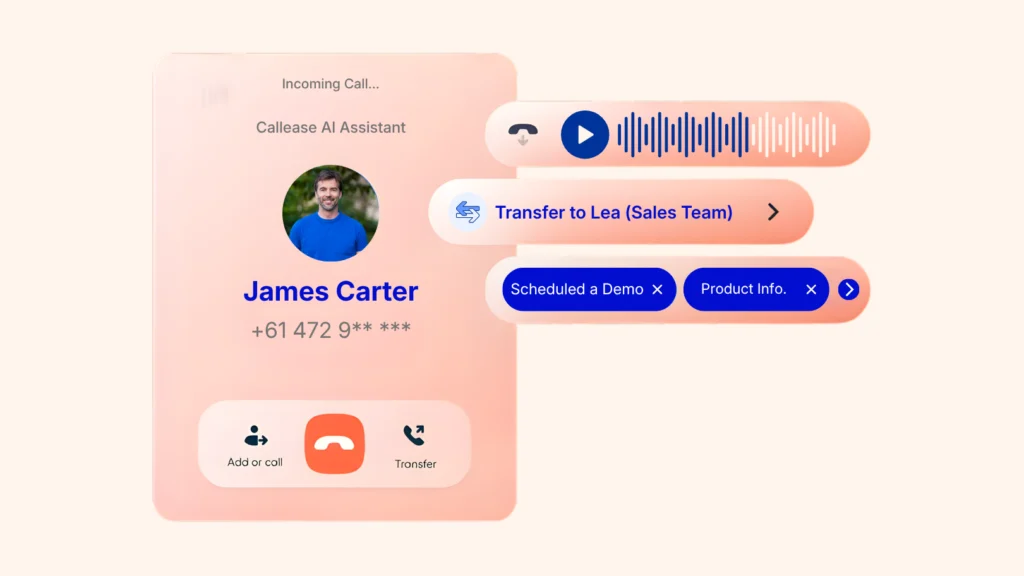
Callease AI is built right here in Australia for businesses that receive a high volume of phone calls and it is one of the ai tools for multilingual customer service. This allows businesses to customise their AI voice agents that sound like a real, friendly person. It is very popular with doctors’ clinics, real estate and this is very popular with doctors’ clinics, real estate agents and sales teams because it handles appointment bookings, quick surveys, and follow-up calls extremely well. Callease uses natural-sounding voices and simple scripts to take care of routine questions so your human team can focus on more complicated issues.
Key Features:
- Sounds very human, with over 100 different voice options to match your brand or region
- Smooth warm hand-off to live agents when the call becomes too complex or emotional
- No-code setup, just write or upload the script, and it’s ready to go in minutes
- Batch outbound calling for sending hundreds or thousands of calls in campaigns
- Automatic CRM updates so every call logs notes, appointments or outcomes instantly
- Performance dashboards that show call success rates, drop-offs and customer feedback
- Best-in-class voice API with multilingual support and region-specific accents for more personalised conversations
Languages: Over 100 languages and accents, full support in higher plans.
Pros
- Scales very well for high-volume international calls and connects smoothly with most CRMs, so customer data updates automatically without manual work.
- The voices really sound natural and the transfer to a live agent feels seamless, which helps keep satisfaction high even on tricky calls.
- You get clear, useful analytics and reports that make it easy to see what’s working and where to improve performance.
- CallEase AI ensures 100% accuracy in every customer conversation for clear, consistent customer interactions.
Cons
- Still building brand awareness compared to older enterprise platforms like IBM Watson or Twilio
- Requires some initial onboarding to fully utilize advanced automation features
- The reporting templates are basic out of the box and need a bit of customization for detailed insights
Best for: Australian businesses that want a locally made tool with strong outbound calling and natural-sounding voices for high-volume support.
2. Synthflow.ai
Synthflow.ai is a no-code platform that lets anyone build powerful voice agents very quickly without writing any code. You simply drag and drop blocks on the screen to create complete conversation flows, which makes it ideal for customer support, appointment booking, follow-up messages and outbound sales calls. It is especially helpful for non-technical teams who want to launch custom voice automation without needing developers.
Key Features:
- Visual drag-and-drop flow builder so you can design conversations like building with Lego
- Real-time call monitoring lets you watch live calls and jump in to tweak or improve
- Connects to 200+ tools, including CRMs, calendars, email and payment systems
- Built-in phone system,m so you don’t need a separate provider like Twilio
- Multi-agent support different AI “workers” that can handle different parts of a call
- Data fine-tuning and learning from past calls to get smarter over time
Languages: 20+ languages (English, Spanish, Hindi, French, German, Portuguese, Italian, Dutch, Russian, Japanese and more) with natural accents.
Pros
- You can launch it very quickly, often in just a few days, and non-technical people can build complex flows without help from developers.
- It delivers very fast responses with excellent security standards (SOC 2, HIPAA) and reliable performance even under high call volumes.
- Most businesses see a fast return on investment because it reduces wait times and handles a large percentage of routine calls automatically.
Cons
- It supports fewer languages than some of the biggest enterprise platforms, so it may not cover very niche or regional dialects as well.
- Costs can increase noticeably if you use premium voices frequently or handle very high call volumes.
Best for: Businesses and teams that want an easy, no-code way to create reliable, custom voice agents without needing technical experts.
3. Retell AI
Retell AI specialises in creating phone conversations that feel like talking to a real, patient and caring person who truly listens. It performs best on incoming support calls where empathy and natural dialogue flow are very important. The tool handles interruptions and overlapping speech smoothly so the interaction never feels stiff or robotic.
Key Features:
- Ultra-low latency replies come in under half a second for natural flow
- Natural interruption and barge-in handling so customers can cut in anytime
- Detailed call analytics showing sentiment, duration, resolution and drop-off points
- Knowledge base integration to pull answers from your docs or website in real time
- Custom prompt control to shape the agent’s tone, personality and rules
- Conversation memory so it remembers what was said earlier in the call
Languages: 30+ languages with auto-translation and smooth switching.
Pros
- Conversations feel extremely natural, caring and human-like, which makes customers much more comfortable and satisfied.
- It meets strict compliance and security standards (HIPAA, GDPR, SOC 2), so it’s safe for sensitive industries.
- It performs especially well on inbound support calls and helps improve overall customer satisfaction scores significantly.
Cons
- It has a steeper learning curve if you’re not comfortable with the technical setup or customising prompts yourself.
- Outbound calling features (cold calling, proactive outreach) are not as strong or mature as its inbound capabilities.
Best for: Support teams that want the AI to sound caring, empathetic and very human on incoming customer calls.
4. IBM Watson Assistant
IBM Watson Assistant is a long-established, enterprise-grade platform trusted by large organisations around the world. It is designed for companies that need extremely reliable voice support across hundreds of languages, together with very strong security standards. It excels at complex self-service menus, IVR systems and high-volume operations.
Key Features:
- Smart conversations linked to company systems for pulling real-time customer data
- Useful analytics and improvement suggestions based on call patterns
- Powers voice IVR and self-service menus with high accuracy
- Orchestrates multi-channel flows so voice works with chat and email
- Built-in speech-to-text and text-to-speech in hundreds of languages
- Enterprise-grade compliance and audit logs for regulated industries
Languages: Hundreds of languages with high-accuracy speech recognition.
Pros
- Offers one of the deepest language coverages available, with very accurate speech recognition in hundreds of languages.
- Provides enterprise-grade security, compliance and massive scalability, which large regulated companies really need.
- Integrates tightly with existing business systems and gives powerful analytics to improve performance over time.
Cons
- Setup and customisation take more time and usually require technical expertise or professional help.
- Pricing becomes expensive quickly when you add advanced features or scale to very large call volumes.
Best for: Large regulated organisations (finance, healthcare, government) that need deep language support, strong compliance and massive scale.
5. Vapi AI
Vapi AI is an API-first platform made specifically for developers who want complete control over custom voice agents. It allows you to build exactly the behaviour and integrations your business requires for both inbound and outbound calls. It is a favourite among technical teams that need maximum flexibility.
Key Features:
- Tool calling and API integrations to connect to any database or system
- A/B testing to compare different scripts or voices side-by-side
- Bring-your-own-model support so you can use your preferred LLM
- Low-latency custom builds for real-time performance
- Automated workflow creation for complex multi-step conversations
- Webhook support for real-time updates during calls
Languages: 100+ languages including English, Spanish, Mandarin and more.
Pros
- Extremely flexible you can build almost any type of voice experience exactly the way you want it.
- Offers fast responses and lets you bring your own AI model, which gives you more control over performance and cost.
- Ideal for creating high-performance, custom-built agents that perfectly match your specific business needs.
Cons
- You need strong developer skills to use it effectively — it is not beginner-friendly at all.
- The real per-minute cost often ends up higher than expected once you include all the different fees (STT, TTS, LLM, telephony).
Best for: Technical teams and developers who want maximum customisation and full control over every part of the voice agent.

6. Bland AI
Bland AI puts strong focus on data ownership, privacy and security. It trains custom models on dedicated secure servers so you keep full control. It scales well for large volumes without losing control or risking data leaks.
Key Features:
- Omni-channel support (voice calls, SMS, chat in one system)
- Sentiment analysis to detect customer emotion and adjust responses
- Custom-trained models that learn only from your data
- Dedicated infrastructure for privacy and reliability
- Voice cloning for hyper-realistic, branded voices
- High concurrency handles millions of simultaneous calls
Languages: Mutiple language without any geographic limits.
Pros
- You own the model and all data completely no vendor lock-in or risk of data sharing.
- Voices can sound extremely realistic and personalised, which boosts customer trust and satisfaction.
- Built to scale safely to millions of calls while maintaining top-level security and privacy.
Cons
- No public pricing page; you must contact them for a quote, which slows down decision-making.
- Geared more toward larger enterprises, so it can feel overbuilt or less intuitive for small teams.
Best for: Companies that prioritise data privacy, full ownership and secure scaling for global operations.
7. Sierra AI
Sierra AI creates agents that remember the customer’s full history across every channel. It unifies phone, chat and other contact methods for consistent, personalised support. It focuses on proactive help and outcomes like solving problems or increasing customer value.
Key Features:
- Agent Studio for fast visual building of agents
- Proactive outreach can message customers when action is needed
- Full customer history retention across all interactions
- Outcome-based performance tracking (e.g., resolution rate)
- Unified omnichannel routing (voice → chat → email)
- Strong security and compliance features (HIPAA, ISO 27001)
Languages: Global multilingual support with personalisation.
Pros
- Remembers full customer history so every reply feels tailored and thoughtful.
- Works across all channels with strong security, making it reliable for sensitive data.
- Quick deployment for large teams and focuses on real business outcomes.
Cons
- Less detailed public info about support for rare accents or very niche languages.
- Outcome-based pricing can feel unpredictable or hard to forecast in early stages.
Best for: Brands that want personalised, context-aware support across multiple channels to build stronger customer loyalty.
8. Twilio Voice
Twilio Voice is a programmable platform with powerful APIs for phone calls. You can build custom voice solutions on its reliable global infrastructure. It gives complete flexibility to teams that prefer to control every detail.
Key Features:
- Speech recognition and IVR menus for self-service flows
- Call tracking, recording and real-time analytics
- Global telephony backbone in 100+ countries
- Easy layering of AI models on top of calls
- Programmable voice routing and forwarding
- SIP trunking and carrier-grade reliability
Languages: Hundreds of languages across 100+ countries.
Pros
- Huge worldwide reach and reliable infrastructure that works almost anywhere.
- You can build exactly what you need with full programmatic control.
- Pay-as-you-go pricing with no long-term lock-in.
Cons
- Requires coding knowledge to make it look and sound polished.
- Extra costs for premium features, telephony minutes and add-ons can add up quickly.
Best for: Teams that love building custom solutions and want maximum control over every part of the voice experience.
9. Poly AI
Poly AI creates premium voice assistants that solve most calls automatically. It specialises in natural conversations for enterprise contact centres. It integrates quickly with existing systems for high-resolution rates.
Key Features:
- Custom voice personas that match your brand tone
- Deep call analytics and containment reporting
- IVR and contact centre integration (Genesys, Five9, etc.)
- Fast enterprise rollout with dedicated support
- Contextual understanding of complex queries
- Multi-turn conversation handling with memory
Languages: Wide range of languages and accents.
Pros
- Very high containment rates solve most calls without human help.
- Handles different accents and languages naturally with good global readiness.
- Strong analytics and quick deployment for large organisations.
Cons
- High custom enterprise pricing that is only available after discussion.
- Less suitable for small businesses or teams wanting heavy no-code control.
Best for: Large contact centres that need high call resolution rates and natural multilingual conversations.
10. Kore AI
Kore AI is a flexible, model-agnostic platform for full AI strategies. It supports voice and multimodal interactions with deep integrations. It suits companies planning long-term, scalable customer service AI.
Key Features:
- Multimodal support (voice + chat + messaging together)
- Agent marketplace with ready-made skills and templates
- Strong CCaaS integrations (Genesys, NICE, Avaya, etc.)
- High-resolution rates with advanced NLP
- Model-agnostic, use any LLM or multiple together
- Built-in testing and deployment tools
Languages
Multiple languages for global markets.
Pros
- Very adaptable and grows with your business and supports complex strategies.
- Achieves high success rates on queries and integrates deeply with major contact centres.
- Flexible model choice and multimodal capabilities for future-proof support.
Cons
- Custom enterprise pricing that is hard to evaluate without a quote.
- Can feel complex and overkill for smaller teams or simple use cases.
Best for: Forward-thinking companies building long-term, scalable AI customer service strategies.

How to Choose the Right AI Voice Agent for Your Business
Three factors set the best platforms apart from the average ones. First off, look for a voice AI that offers support for multilingual streaming and persona management – i.e., the voice AI can change languages in the middle of the call and adjust the tone accordingly. Secondly, look for a voice API that offers support for multiple languages and regional accent support instead of the typical robotic voice. Finally, consider the cost factor with affordable options like multilingual voice cloning available in 2026. Following are the points that will help you to choose the best multilingual AI voice agents among all.
- Which languages do most of your customers actually speak? (If you have a lot of English or French callers, pick something with strong coverage in those.)
- Do you already use a CRM (like HubSpot or Salesforce) or a call system (like Genesys or Five9) that needs to connect smoothly?
- How fast do answers need to be? (Aim for under half a second delay if you want conversations to feel really natural.)
- What budget style fits best: pay-per-minute (good for starting small) or a fixed monthly plan (easier to predict costs)?
- Do you want something super easy with no-code drag-and-drop, or are you happy to get technical for full custom control?
- How important is compliance or privacy to you? (Banks, healthcare or government clients often need HIPAA/GDPR/SOC 2 level security.)
A practical approach is to start small. Select one or two platforms and test them on simple, repetitive queries first (like “what are your opening hours?”, “track my order” or “reset my password”). Conduct 50–100 test calls, review recordings, analyse customer responses, and refine the conversation flow before scaling. That way, you avoid wasting money and find the best fit quickly.
Conclusion
In 2026, AI voice agents are transforming multilingual customer support, making interactions faster, more cost-efficient, and more natural.
Callease AI stands out as top voice ai tools for multilingual customer conversations, particularly those seeking natural-sounding voices, outbound calling capabilities, seamless CRM integration, and responsive local support.
For smaller teams or technical environments, platforms such as Vapi AI and Twilio Voice offer flexible alternatives. Larger enterprises with advanced compliance or scaling requirements may consider solutions like IBM Watson Assistant or Kore AI.
Ultimately, the right platform depends on your operational needs, customer base, and long-term automation strategy.
FAQs
The AI voice agent to use for multilingual customer support depends on the nature of your business. For instance, if you need natural voices with 100 or more languages with easy setup and CRM integration, you should consider using Callease AI. For enterprise-level business, you should consider using IBM Watson Assistant, as it supports hundreds of languages with strong compliance. For developers, you should consider Vapi AI, as you will have full control with 100 or more languages and flexible pricing.
The best multi-language text-to-speech services to use for automated calls in 2026 will be Callease AI with 100 or more natural voices, Bland AI with voice cloning for branded voices, and Twilio Voice with hundreds of languages and carrier-grade reliability. For outbound calls, you should consider Callease AI, as it supports batch calling with 100 or more languages with automatic updates to the CRM after every call.
Yes, you can find cost-effective multilingual voice cloning services with Callease AI and Vapi AI, as they are the most cost-effective options with flexible pay-as-you-go pricing with competitive monthly plans supporting 100 or more languages. Twilio Voice supports pay-per-minute pricing with no lock-in contract. These three options are good places to begin with when you need quality multilingual voices without a hefty upfront cost.