Managing phone calls effectively is currently one of the most daunting tasks for today’s businesses. Whether it is responding to incoming customer inquiries or making outgoing follow-up calls, setting appointments, and authenticating incoming callers, conventional phone management systems are often hard-pressed to keep pace. Manual phone management is not only time-consuming and costly but also impossible to scale.
Callease AI provides a more intelligent solution with its highly advanced AI calling agent, which aims to fully automate phone calls while still providing a natural and human-like experience. With complete control over both the front-end and back-end of the solution, Callease AI provides a dependable AI phone automation solution that can help businesses increase efficiency, lower costs, and boost customer interaction.
Perhaps you feel that implementing a voice agent in Callease could be a bit of a challenge. In that case, this guide is meant for you. In this article, we will discuss how AI phone calling works and how you can implement a Callease AI Phone Agent for your business.
How to Set Up Your Callease AI Call Agent – Step -by-Step Guide
Once you decide that Callease AI is the platform you want to go for your call automation needs, then setting up a customized AI voice agent in Callease is very easy. You don’t need any advanced coding knowledge; you can follow the simple steps mentioned below, and your personalized calling solution is ready to work.
Step 1: Subscription and Initial Setup
The setup starts with a subscription to Callease AI and a plan that matches your business size, call volume, and operational needs. After registration, the Callease team completes the core technical setup, including phone connectivity, call routing, and integration with essential tools, so your AI phone system is fully ready for configuration and use.
This step includes:
- Choose the right subscription plan
- Create your Callease AI account
- Set up phone numbers and call routing
- Connect calendars and essential tools
- Complete security verification checks
Step 2: Configure Call Workflows
Once the system is ready, define how the AI handles different call scenarios. This includes inbound calls, outbound campaigns, and rules for when calls should transfer to human agents. Adjust language and accent settings for global reach, which is especially useful for ai voice agent Australia solutions.
This step includes:
- Define rules for inbound and outbound calls
- Set call transfer criteria to human agents
- Customize response templates to match your brand
- Configure language and accent preferences
- Align workflows with business processes
Step 3: Train the AI with Knowledge Base
The AI agent requires a knowledge base to respond accurately. Upload product details, service information, FAQs, and scripts. Create prompt libraries to guide the AI for fast and precise responses. Over time, the AI caller learns from real interactions, improving response quality.
This step includes:
- Upload your business knowledge base
- Create prompt libraries for quick responses
- Align AI responses with brand tone and policy
- Review and refine answers for accuracy

Step 4: Test and Optimize
Before launch, test the AI system to verify call quality, response accuracy, and operational performance. Identify any areas for improvement and adjust call workflows or responses accordingly. This ensures a smooth AI phone call experience for customers.
This step includes:
- Conduct test calls for inbound and outbound scenarios
- Verify response accuracy and call routing
- Refine workflows based on results
- Confirm system reliability and readiness
Step 5: Go Live and Scale
After testing, launch your AI phone agent. Automate inbound support, outbound follow-ups, appointment reminders, and customer verification. Monitor performance with analytics dashboards to optimize customer engagement. For businesses implementing AI call automation in Australia, this step allows immediate improvements in efficiency and service quality.
This step includes:
- Activate the AI phone system for live calls
- Automate routine interactions and follow-ups
- Monitor performance through analytics
- Adjust workflows to improve engagement
If you are wondering if there are multiple AI voice assistants available, then why should we opt for Callease? The answer to this question is: Callease AI is different.
What Makes Callease AI Different
Callease AI is more than a simple automated calling system. It is a fully functional AI calling assistant designed to handle actual business conversations for both incoming and outgoing calls.
End-to-End Call Handling
Callease AI handles the entire process of calls from start to finish, including answering incoming calls, making outgoing calls, setting up appointments, and collecting customer details. The system is fully integrated with your existing business applications.
Intelligent Verification and Call Routing
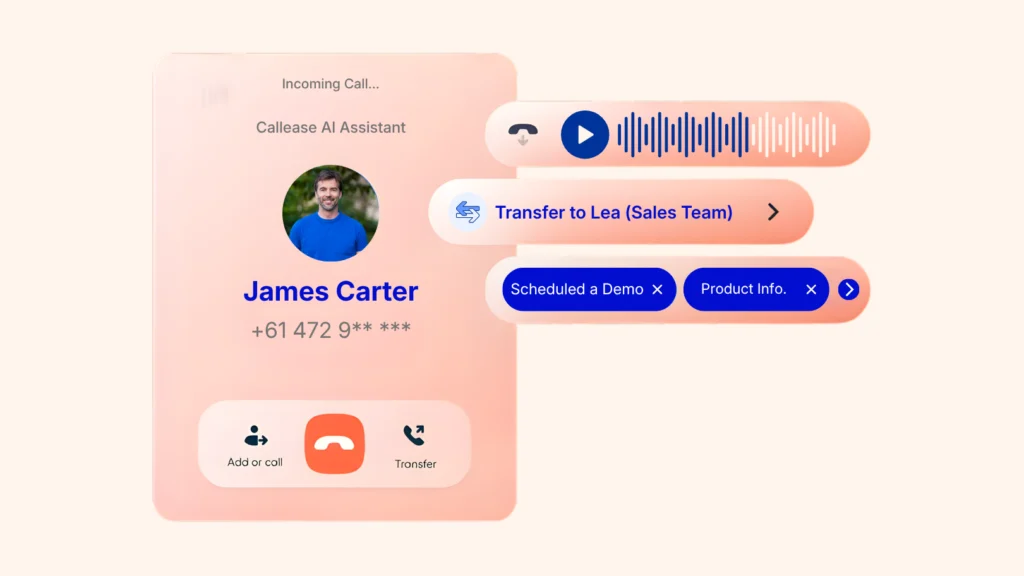
The system has the capability to verify the caller before processing any sensitive requests and can also route calls to human assistants as needed. This provides security without compromising the customer experience.
Contextual and Human-Like Conversations
Unlike a simple IVR system, Callease AI has the capability to understand context and respond to it in a human-like conversation. Each ai phone call is natural while taking advantage of the speed and consistency of automation.
Actionable Data and Insights
Each call provides actionable data that can be used for reporting, optimization, and performance analysis. Businesses get complete visibility into call results, customer behavior, and engagement patterns.

Conclusion
The idea of AI calling is no longer a vision for the future but is now an integral component of business communication. With Callease AI, businesses get an effective AI calling agent that can handle both incoming and outgoing calls while delivering a natural and human-like experience to customers. Callease ensures 100% accuracy in every conversation, enabling businesses to rely on consistent and precise communication at scale. The AI calling agent can manage common conversations, validate customer details, transfer calls to human customer service representatives when necessary, and generate valuable insights from each interaction. With this technology, businesses can save valuable time, reduce operational expenses, and deliver high-quality customer service at every touchpoint. It adapts to different situations, improves efficiency, and allows teams to focus on complex tasks that require human attention.